Sunday
Jan232011
russ warren video
 Sunday, January 23, 2011 at 05:19AM
 I want to thank Russ Warren and Lyn Warren again for helping to make this happen.

 Sunday, January 23, 2011 at 05:19AM
 I want to thank Russ Warren and Lyn Warren again for helping to make this happen.
Friday, January 21, 2011 at 11:35AM ;) Gray Winter Morning
Gray Winter Morning
Feels like I might recover after all.
Cormac McCarthy, The Road, post apocalyptic in books Saturday, January 8, 2011 at 11:55PM ;)
;)
Once again, I've been busted for entering and carrying a camera around "private" property. The question that I am asked most frequently: "Who are you with?" I find it increasingly difficult to not look around me, throw up my hands, and give my questioner a look of incomprehension, wondering if their senses are fully functional. Instead, I answer in the manner I know is expected. My response might not be what they expect, since I am always alone. This curious assumption, that an individual with a camera could not possibly be simply an individual with a camera, leaves me wondering. What are the expectations for picture taking? Does it (the picture taking) always have some ulterior profit seeking motivation involved?
The next question tends to be, "What are you doing?" An explanation of the aesthetics of New Topographics and its relationship to the ManMadeWilderness in twenty-five words or less is not what they are looking for. Nor would they expect me to ask what they are doing to the land we are standing on. Even the slightest objection to their authority is not usually necessary to hear the rationale for exclusion, the inevitable "If/when you fall down and break your head open, you're going to sue for damages."
It is interesting that the camera - the cause for the exploration of the private property - is not a contested item. It is mere bodily presence that constitutes offence. Land owners don't object to photographs of whatever they are doing to the land. They are concerned that trespassers will injure themselves and come after them (the owners) for damages. We have become a nation of litigious land owners looking out for our individual rights to exploit that land however we desire. The guy who got there first(?) or has the biggest pile of cash gets to control access. We've reached the point that there are no common areas, other than park lands owned by the State, and small tracts along roadways and around water features that are owned jointly by neighborhood associations, all courtesy of our common law heritage of land tenureship.
;)
;)
Hollymead, private property, trespassing in motivation, rant Tuesday, January 4, 2011 at 03:30PM ;) click 'er for biggerAt last there is some thaw from the past few weeks of freezing temps. Enough that the ice on the Loftlands pond has mostly disappeared. A gorgeous gray day reveals the intensity of the colors of the landscape.
click 'er for biggerAt last there is some thaw from the past few weeks of freezing temps. Enough that the ice on the Loftlands pond has mostly disappeared. A gorgeous gray day reveals the intensity of the colors of the landscape.
This may be the first image out of the 7d that I'd like to see printed on paper, but instead I'm using it as a sketchpad for what else it might be: yesterday I took the Linhof out and used film to record the same location. Although another day of warmer temperatures has melted the ice almost completely. And of course the light was quite different, so it's hardly the same photograph. This is good enough for now.
Loftlands, ice, pond in my aesthetic, the recent past Friday, December 31, 2010 at 01:11PM ;) KW, JHW, RW
KW, JHW, RW
Only a year ago, this is what we looked like. Remarkable progress, I'll have to say.
I asked for readers to share their family photos last year. Unfortunately no one took me up on it. How about this year? Anyone?
Apple, computers, holidays, taptops in A Perfect Nearness, the recent past Tuesday, December 21, 2010 at 02:13PM 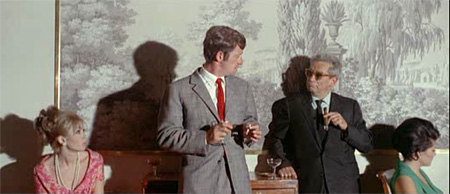
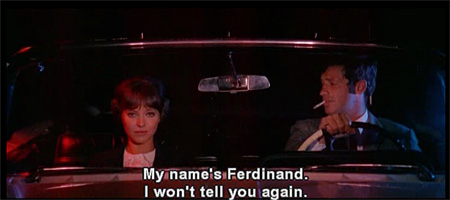
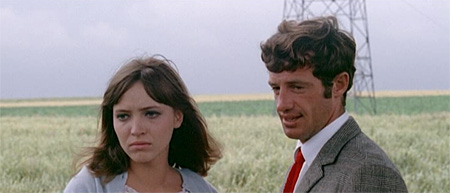
Directed by Jean-Luc Godard, 1965.
w/ Jean-Pierre Belmondo & Anna Karina
A fractured mixture swatted back and forth - much like the tennis ball in the opening shots of the film - between art and pop, comprehension and abstraction, and subtlety and cliche, Pierrot is Godard's tenth feature. Apparently it was largely improvised during the two months of shooting, with the dramatically confusing later sections on the Mediterranean filmed first. With this in mind, it becomes understandable how the early sections of the film become a necessary clarification for where the characters and the film must head in order to end up with what they had already filmed.
The film begins with the narrator, presumably Ferdinand as played by Belmondo, reading from a book about Diego Velazquez to his daughter while sitting in a bathtub smoking.
Past the age of 50, Velasquez stopped painting definite things. He hovered around objects with the air, with twilight, catching in his shadows and airy backgrounds, the palpitations of color which formed the invisible core of his silent symphony. Henceforth he captured only those mysterious interpenetrations of shape and tone that form a constant, secret progression, neither betrayed nor interrupted by any jolt or jar. Space reigns supreme. It is as if an aerial wave, sliding over the surfaces, soaked up their visible emanations, defined and modeled them, then spread them about like a perfume, an echo of themselves, a scattering of impalpable dust.
The world he lived in was one of sadness, a degenerate king, sickly infants, idiots, dwarfs, cripples, a handful of clownish freaks dressed up as princes, whose function it was to laugh at themselves and to amuse a cast that lived outside the law, in the meshes of etiquette, plots and lies, bound by the confessional and remorse, with the Inquisition and silence at the door.
A spirit of nostalgia pervades his work, yet he avoids what is ugly, sad, or cruelly morbid about those oppressed children. Velasquez is the painter of evening, of open spaces and of silence, even when he painted in broad daylight or in a closed room, even with the din of battle or of the hunt in his ears. As they seldom went out during the day, when everything was drowned in torrid sunshine, the Spanish painters communed with the evening.
While Ferdinand appears to be reading from a published book, the text more probably belongs to Godard, with his claims that the 17th century painter abandoned his typical court scene paintings in later life and “...captured only those mysterious interpenetrations of shape and tone that form a constant, secret progression...” What is most probable is that Godard had edited his film, found it wanting, and decided that his final attempt to solidify the pieces would be to add this description to and about a film that he wished to make but had eluded him.
It's difficult to watch this post modernist “classic” with the eyes and sensibilities of a “modernist,” trained as we are to expect the elements of the MAVM to distract our attention from the artifice of the presentation in front of us. Godard as well as anyone within commercial cinema knew the conventions that were expected of someone in his position, wielding as much money as he certainly did for this feature. Which creates a tension that propels us forward, into what the characters say is either an adventure or a romance. What else does Hollywood know in its continual insistence that “the story” is the only use to which film should be put? Godard progresses onward using a variety of the conventions of commercial cinema, but regularly drops the mask of artifice in order to remind us that we are watching a movie. At the end, after a literally explosive conclusion that is a mixture of comedy and cliché as well, a pair of whispered voices are heard over a pan to the right over the vastness of the ocean.
She: It's ours again.
He: What?
She: Eternity.
He: No that's just the sea. And the sun.
It's neither an adventure nor a romance, there's nothing omniscient or religious in the experience. But in it's way it is. It's only a movie. But it's a Jean-Luc Godard movie.
Belmondo, Godard, Karina in world cinema Saturday, December 18, 2010 at 09:58AM ;) click 'er for bigger
click 'er for bigger
Ever the wise-ass, and having a hard time taking seriously any serious taking voice of authority, my recent chance encounter with a member of the local fourth estate was one of the more enjoyable random moments that's taken place recently. Probably suspecting that I was a barely compliant participant, my interviewer kept the session short. Probably best, in the long run. After all, they're looking for entertaining sound bites, not memorable wisdom. I was rather incredulous that I was being requested to voice my thoughts about the topic of snow shovels. I mean, really. This passes for journalism? Where can I get one of these jobs?
It goes to show that there is next to no chance of being "discovered" in a big box store. This is the reason I patronize my local hardware store, in this case being Martin Hardware, in Charlottesville. You never know quite what sort of an encounter will take place there. But you can be pretty certain that you'll get the item that you need.
Martin Hardware, fame, jokes, snow shovels in pmc, the recent past, weather Saturday, December 4, 2010 at 04:09AM What does happen to road kill? No doubt some have wondered what became of Mephitis mephitis. It doesn't go to waste, that's for certain.
;) click 'er for bigger
click 'er for bigger
The day after taking this photo, when I passed by again, there was nothing left. The system was doing it's part to clean up the remains. The only evidence of the demise of this animal is an odor that lingers in the area, not from any body parts, but from residual oil deposited on the pavement at the time of death.
Loftlands, Mephitis mephitis, skunk in road kill, the recent past Saturday, November 27, 2010 at 05:00PM ;) click 'er for bigger
click 'er for bigger
Our local plaza, within walking distance of the house, used to be a lively assortment of small businesses. When we moved to Earlysville 11 years ago there was a moderately sized food market, a pizza restaurant, a lawyer's office, all generating a fair amount of traffic. Through the go-go Shrubbery years the market changed hands and was given some updates, a furniture business sprouted across the street run by an energetic young couple, and traffic was substantial enough for the landlord to banish yard sales from the adjacent parking lot to accommodate parking for the corner businesses. Fast forward to 2010: there isn't a single business presence in any of the space.
Of course no one is blameless. There was a fair amount of intrigue surrounding the coming and goings of the furniture store proprietors, as in divorce, rumors of embezzlement, etc. Nor should one ignore the outside influences brought to bear: a large supermarket chain opened a massive new store only about five minutes away. Were people willing to forgo the better choice and pricing in order to support the smaller more local market? It didn't seem so, myself included.
Curiously enough, the much smaller country stores scattered around the area appear to still be doing fine, specializing as they do in pickled eggs, chaw, beer, and the white necessities (toilet paper, white bread, eggs, milk) always required prior to a snow storm. As seems to be the case in so much of commercial enterprise these days, there is little or no middle ground. We have Mega Marts in every town, or one location bodegas.
Earlysville, Whyte's, business in mirrors, ramblings of the mind Sunday, November 21, 2010 at 09:26AM The Trial of John Mosby from Man Made Wilderness on Vimeo.
At ten minutes, our piece of the Albemarle/Charlottesville Historical Society's annual Spirit Walk fundraiser is the longest by far. This is a compilation of several of our performances from the final day. Please excuse the substandard sound. There is still the possibility of looping all the lines. I might talk to the cast about doing that.
Spirit Walk, video Saturday, November 13, 2010 at 06:04PM ;) click 'er for bigger
click 'er for bigger
;) click 'er for bigger
click 'er for bigger
;) click 'er for bigger
click 'er for bigger
Really, I'm not searching for this stuff. I go out walking in the morning, and this is what I find. Along with some beautiful scenery. But who cares about that, right? We want sensationalism. We want fires, and murder, and car crashes. But in presenting it here, on a landscape site, am I not falling prey to the same cheap motives that the rest of the media employs? I've wondered before how far one can go with representational photography before you have entered the zone of exploitation. These images are pretty tame: they simply report the incident. As victims of road killings, there was likely little suffering involved. If I was to trap animals, run over them or butcher them, and then photograph the results, it would be a different matter. But can anyone really determine that I wasn't in fact the cause of these animals' deaths?
BTW - nothing has been moved in order for clarity. The final photo, of Mephitis mephitis, shows an animal that was killed on the road and moved into the brush by someone else.
Tuesday, November 9, 2010 at 11:47AM 
Conceived and directed by Godfrey Reggio, I remember seeing this remarkable film at the New York Film Festival in 1983. Two more films, Powaqqatsi, and Naqoyqatsi, complete the trilogy. These are words from the Hopi language, with Koyaanisqatsi being translated by Reggio as meaning "life out of balance." In his commentary - as a separate piece on the dvd - the director explains that his unique combination of image and music is a way to examine the modern world, the world of technology. He feels we are no longer living in a natural state, but are now living "above" the earth, isolated from our historical connection by the layer of technology that encompasses the globe.
The film's role is to provoke, to raise questions that only the audience can answer. This is the highest value of any work of art, not predetermined meaning, but meaning gleaned from the
experience of the encounter. The encounter is my interest, not the meaning. If meaning is the point, then propaganda and advertising is the form. So in the sense of art, the meaning of KOYAANISQATSI is whatever you wish to make of it.
On the surface level of mechanics, the film consists largely of time lapse images created by the cinematographer Ron Fricke. By now we have seen these images repeatedly - the accelerated traffic flows in New York and Los Angeles; production lines in a Twinkie factory, a hot dog factory, an automobile factory - but there are others of the earth and individuals in the mass of humanity that are perhaps more striking for their inclusion in a vision of machine technology.
This powerful combination of images and music, the latter by Philip Glass, is like few others: there is no linear story, there is no narration, there is no actual subject. It is an experience waiting for a viewer.
Sunday, October 31, 2010 at 05:00PM Carving from Man Made Wilderness on Vimeo.
A time lapse from last night's pumpkin carving. Concept mostly by Claire, then we edited together this afternoon. Pushing up against the limitations of my knowledge of Final Cut Pro's abilities to do text credits without descending into Motion, we opted for none.
Friday, October 29, 2010 at 01:33PM CHOOSE from Man Made Wilderness on Vimeo.
This is one that came to me from good friend Craig MacDonald in upstate New York. He's been recording music with friends from his high school days, the band now christened Old Scots. They get together maybe once a year, but Craig has managed to produce an entire album of music with the three of them playing together, by passing digital files back and forth. The same was done with this video. As can be seen, the images come from four different sources, and I managed through the wonders of software to stuff them into a single format that is viewable.
Craig MacDonald, John Burns, Old Scots, Steve Taylor in guest contributors, music, video Saturday, October 23, 2010 at 11:54AM Here's the audio from one of our performances last night, as part of the annual Spirit Walk. A bit boomy, but audible. I'll try for better placement of the recorder tonight, all as tests for Sunday afternoon's video recording.
KMW
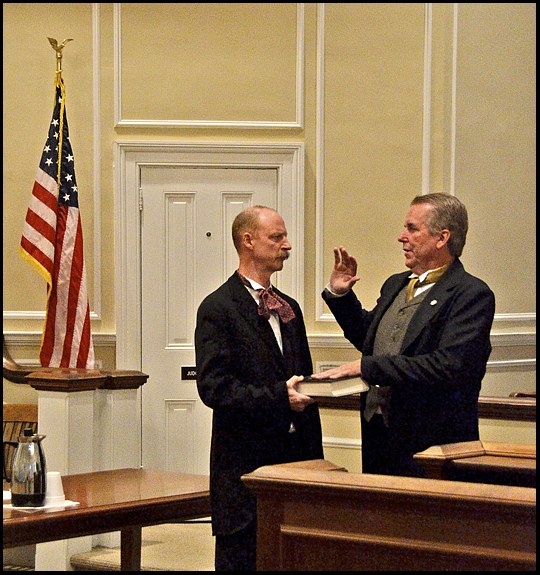 photo by James Marshall
From one of our performances Saturday evening.
For those clamoring for the video - sorry, it's going to be a while longer. I'm still editing a music video to go online by tomorrow morning.
Mosby Trial in Spirit Walk Sunday, October 17, 2010 at 05:15PM What happened to me? No more still photography, basically. The GD Canon 7D has taken over my sensibilities, and Final Cut Studio the rest of my waking hours.
Here's the product of the latest marathon.
Who's Afraid of 50? from Man Made Wilderness on Vimeo.
A party last night, and in less than 24 hours it's online. It's been a long time since I stayed up til 5am working on a project, but this morning seemed to be the time to do it. Maybe there was something in the food last night that kept me awake. Or maybe it was the enchantment of cinema...
KMW
A new version available already, to fix some duplication that was missed in the early hours this morning.
Cargil, Charlottesville, Dave & Gail, party in motivation, the recent past, video Sunday, October 17, 2010 at 05:09PM For the fifth year, I'm going to get up on the boards, figuratively speaking. I've ascended to the primo location for characters who perform for the Spirit Walk, the Historical Society's annual fundraiser: the interior of the Albemarle County Courthouse. I'll be playing the Commonwealth Attorney from 1853 with four other actors. It should be a blast. If you're in the area, get a ticket and do the tour.
COME JOIN US FOR THE 16TH ANNUAL SPIRIT WALK!
The Spirit Walk is a guided evening tour of Historic Downtown Charlottesville and Maplewood Cemetery. What really makes the Spirit Walk unique, however, besides it’s being at night, is that along the way, you actually come across and interact with ghosts from Charlottesville’s past. In fact, each tour is led by an actor in full costume representing a spirit from Charlottesville’s history! The Spirit Walk is the number one fundraiser for the not-for-profit Albemarle Charlottesville Historical Society whose goal is preserving and nurturing appreciation of local history.
WHEN:
October 22nd, 23rd, and 24th. …. One weekend only!
Tours run every 15 minutes. On Friday the tours start at 6 and the last tour leaves at 9:15. Saturday, 5 to 8:15. Sunday, 4 to 7:15.
PRICE: 12 for Adults…8 for children under 13 years old
Get your tickets online at:
Or call:434-296-1492
Or Stop By!:
200 2ND STREET SE…ACROSS FROM LEE PARK, BEHIND MAIN BRANCH OF LIBRARY
Hope to see you there!
Monday, August 16, 2010 at 04:01AM ;) click 'er for biggerApparently it was a slow day. Or more likely the officer was new to the job and needed some experience. Details of my encounter with the CSX police can be found here. I was warned because I was supposedly within 24 feet of a railroad track. This photo is pretty good evidence that I was on the edge of the road, probably about 25 feet away from the track that runs down the middle of a public road. But who's quibbling? Believe it or not, the railroad was not what I was photographing. I probably won't be returning to South Kearny, N.J. any time soon.
click 'er for biggerApparently it was a slow day. Or more likely the officer was new to the job and needed some experience. Details of my encounter with the CSX police can be found here. I was warned because I was supposedly within 24 feet of a railroad track. This photo is pretty good evidence that I was on the edge of the road, probably about 25 feet away from the track that runs down the middle of a public road. But who's quibbling? Believe it or not, the railroad was not what I was photographing. I probably won't be returning to South Kearny, N.J. any time soon.
CSX, S. Kearny, power lines, railroad police in Large Format, rant, the recent past Saturday, August 14, 2010 at 08:48AM ;) click 'er for bigger
click 'er for bigger
This is a photograph that could benefit from an audio component. Or at least it would make the reality of its nature more immediate. But as I wrestle with what it is that I want to do with a motion picture capture device, it is fairly obvious that what "typically" works is not a collection of still images, even complimented with sound. The question that is posed by director Peter Watkins in his critique of the media and film making, is whether we can find other means of communication through visual media that transcends the hegemony of the three act structure of virtually all story telling.
This extreme crisis for global civil society AND for the environment, falls into six principal areas under examination: • the role of the American MAVM [Mass Audio Visual Media], with their disastrous impact on global politics, social life, and culture • the somewhat less obvious, but equally dangerous role of the MAVM in most other countries • the role of global media educators (encouraging young people to enter the mass media as acquiescent professionals, or to accept the mass media as passive consumers) • the role of film festivals and of film makers themselves • the complex role of the counter-culture movement • the role of the public.
Crucial to Watkins' analysis of the MAVM is his examination of the Monoform:
To explain to new readers: The MONOFORM is the internal language-form (editing, narrative structure, etc.) used by TV and the commercial cinema to present their messages. It is the densely packed and rapidly edited barrage of images and sounds, the 'seamless' yet fragmented modular structure which we all know so well. This language-form appeared early on in the cinema, with the work of pioneers such as D.W.Griffith, and others who developed techniques of rapid editing, montage, parallel action, cutting between long shots/close shots, etc. Now it also includes dense layers of music, voice and sound effects, abrupt cutting for shock effect, emotion-arousing music saturating every scene, rhythmic dialogue patterns, and endlessly moving cameras.
He proposes alternative ways of viewing (see especially this section of his statement), and that the entire process of media production become more democratic through subjects and audiences becoming involved and a part of the means of communication. After all, the word implies some sort of two way process, rather than the simple passivity of a silent audience in a cinema or on the couch in the living room.
Can a lone landscape photographer find a way through this minefield?
I 95, Richmond, boulders, interstate in Large Format, manmadewilderness, my aesthetic, process, the recent past Thursday, August 12, 2010 at 08:09AM ;) click 'er for bigger
click 'er for bigger
Perhaps time to find out where they go? In our case, the coal fields of south Virginia and West Virginia.
Wayneboro, field, power lines in Large Format, the recent past